
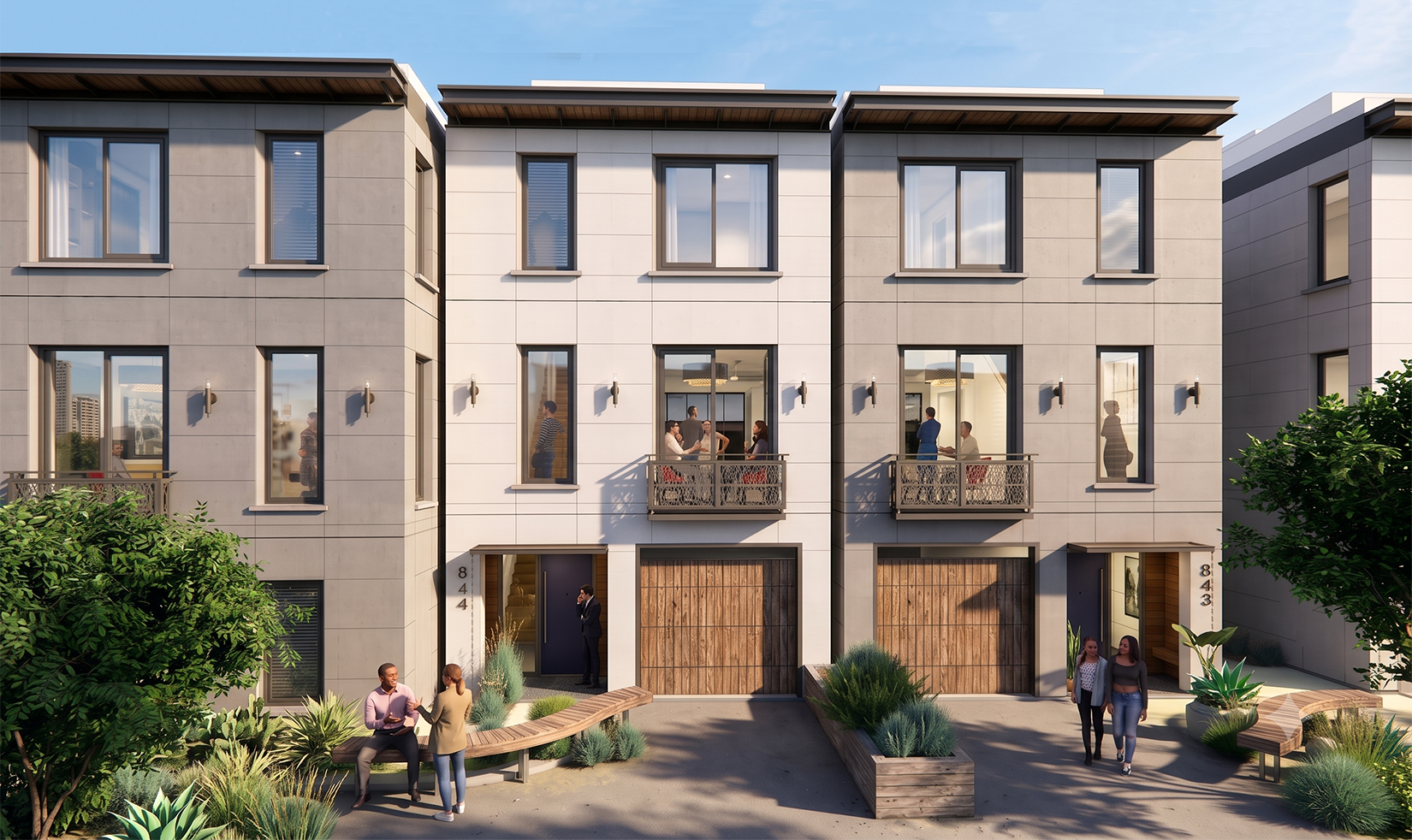
A powerful infill housing tool for property owners, new and experienced development teams
We are seeing real time proof that California’s SB 684 is creating new opportunities for housing statewide by making it easier to subdivide urban lots and deliver new homes in established neighborhoods. For developers considering infill development, SB 684 is one of the most effective tools available for transforming underdeveloped multi-family residential properties into high-value housing that is both desperately needed in our communities and profitable to build.
At Studio KDA, we see SB 684 as a highly versatile tool for developers throughout the state. Our current work demonstrates the broad range of project types this legislation supports. Examples include a new 1,750 sf home for a young couple in the backyard of an existing home in a desirable neighborhood (a standard ADU is typically capped around 1,000 sf in most jurisdictions), The Morgan, a 6-unit luxury housing project for retirees seeking to leave hillside homes for more walkable neighborhoods, and a new 31-unit rowhouse subdivision (SB 684 overlaid on several contiguous lots) in North Berkeley designed for young families. Together, these projects show that SB 684 is not limited to one housing model; it supports thoughtful infill at multiple scales.
SB 684: Three Key Advantages
- Financeable / Profitable
The legislation supports creation of fee-simple single-family homes or townhomes for sale, often without the burden of condominium ownership structures. That means projects avoid the complexity associated with HOAs, monthly association fees, and extensive CC&Rs, making the resulting homes both more attractive to buyers and simpler to deliver.
This creates a compelling value proposition: high-value, relatively cost-efficient projects that pencil more easily than conventional condominiums or large-scale apartment buildings.
- More reliable approvals through ministerial processes
A second major benefit is the ministerial approval process, rather than the traditional lengthy and uncertain discretionary review. For developers, this means a predictable entitlement pathway without exposure to potentially divisive public hearings, neighborhood opposition, and subjective commentary.
Predictability reduces holding costs, improves financing confidence, and shortens the path from concept to construction.
- Increased development potential on qualifying sites
SB 684 also substantially improves the development potential of urban parcels. On qualifying sites, it often allows more units than would otherwise be allowed, while also easing development constraints such as height, setbacks, lot coverage, and floor area ratios (FAR). This flexibility can be critical in making infill projects workable from both a design and financial standpoint.
For California property owners, this means that land which once supported only conventional housing may now accommodate a more desirable, affordable residential program.
Applicability
SB 684 is relevant across all California jurisdictions, and Studio KDA is seeing growing potential for these projects throughout the SF Bay Area and beyond. When considering a site, note that there are important qualifiers:
- Sites must be zoned for multifamily development (single-family can work in limited cases);
- Existing rental units typically cannot be demolished;
- Individual sites may only have up to 10 units unless subdivided first;
- Average unit size cannot exceed 1,750 sf. Keep in mind that this is an average, not a cap.
Additional legislative and practical site considerations may also affect applicability.
A capable architect, experienced with SB 684, can help developers assess whether a property is a good candidate, test site yield and building form, and help shape a development strategy that aligns the legislation with local requirements and market opportunity. Properly understood and implemented, we expect SB684 to be a key component of addressing the state’s serious housing shortfall.